


Corvette Generations Explained: C1 Through C8
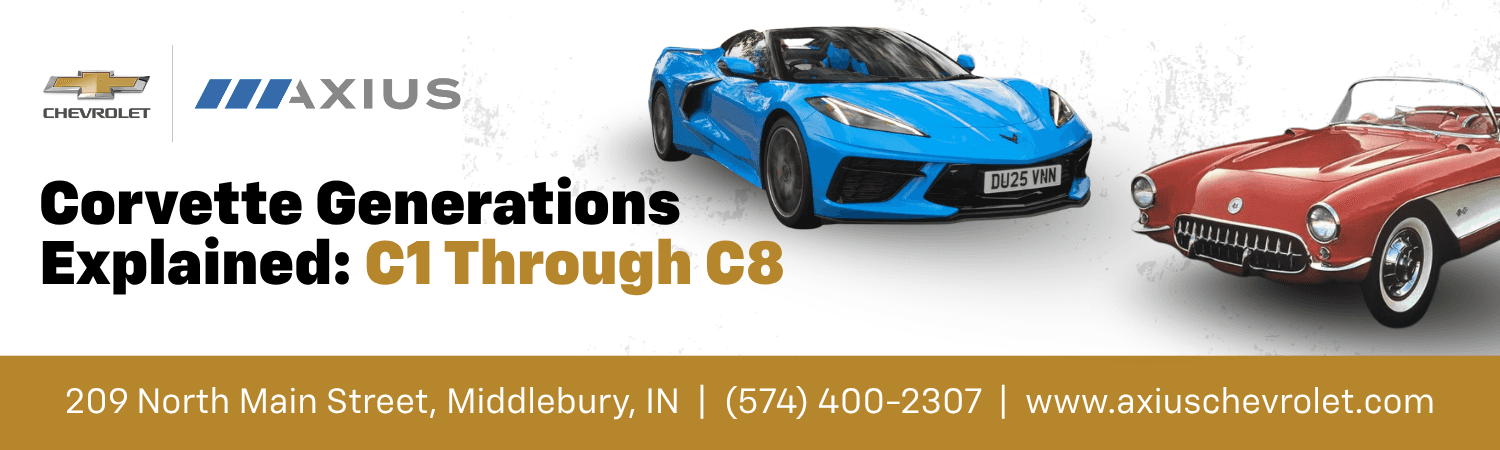
The Chevrolet Corvette has been one of America’s most recognizable sports cars for more than 70 years. Since its introduction in 1953, the Corvette has gone through eight distinct generations, with each one bringing major changes to its design, engineering, performance, and technology.
From the fiberglass-bodied C1 to the mid-engine C8, every Corvette generation reflects the automotive technology and performance expectations of its era. Some generations introduced engines that became legendary. Others completely changed the Corvette formula. Together, they tell the story of how Chevrolet transformed the Corvette from a small American sports car into a global performance icon.
If you have ever wondered what separates a C1 Corvette from a C8, this guide breaks down every Corvette generation and explains what makes each one special.
What Does “C1” Through “C8” Mean?
The letter “C” followed by a number is commonly used to identify each generation of the Chevrolet Corvette. C1 refers to the first-generation Corvette, while C8 represents the eighth and current generation.
These generation designations make it easier for enthusiasts, collectors, and shoppers to distinguish between major eras of Corvette development.
The eight Corvette generations are:
- C1: 1953 to 1962
- C2: 1963 to 1967
- C3: 1968 to 1982
- C4: 1984 to 1996
- C5: 1997 to 2004
- C6: 2005 to 2013
- C7: 2014 to 2019
- C8: 2020 to present
While there were numerous updates, special editions, engine changes, and styling revisions within each generation, each C designation represents a major step in Corvette history.
C1 Corvette: The Beginning
The C1 Corvette launched the nameplate in 1953. Chevrolet introduced the car as a two-seat American sports car, and the earliest Corvettes were built with fiberglass bodies. That lightweight construction became an important part of the Corvette identity.
The first Corvette used a 235-cubic-inch inline-six engine paired with an automatic transmission. Chevrolet later introduced the small-block V8, which dramatically changed the car’s performance potential.
The first-generation Corvette went through several styling changes during its production run. Early cars featured a rounded body and distinctive grille, while later C1 models developed a more aggressive appearance.
The 1956 model year brought one of the most recognizable C1 redesigns, with a more defined body and external door handles. By the end of the generation, the Corvette had established itself as a serious American performance car.
The C1 is especially important because it laid the foundation for everything that followed. Without the first Corvette, there would be no C2 Sting Ray, C3 Stingray, or modern C8.
C1 Corvette Highlights
- First Corvette generation
- Fiberglass body construction
- Introduction of the Corvette small-block V8
- Classic 1950s and early 1960s styling
- Two-seat sports car configuration
C2 Corvette: The Sting Ray Arrives
The C2 Corvette, produced from 1963 through 1967, is one of the most celebrated generations in Corvette history.
The 1963 Corvette introduced the Sting Ray name and a completely new design. Its sharp lines, hidden headlights, split rear window, and sculpted body gave it a dramatic appearance that was unlike the rounded C1.
The split rear window was exclusive to the 1963 coupe, making that particular model one of the most recognizable and collectible Corvettes ever produced.
Performance also became a major focus during the C2 era. Chevrolet offered increasingly powerful V8 engines, including big-block options. The Corvette could be ordered with performance-oriented equipment such as fuel injection, heavy-duty suspension components, and four-wheel disc brakes.
The legendary Corvette Grand Sport also debuted during this era as a lightweight racing-focused development, although production was extremely limited.
The C2 established many design cues and performance characteristics that would influence the Corvette for decades.
C2 Corvette Highlights
- Introduced the Sting Ray name
- Famous 1963 split-window coupe
- Independent rear suspension
- Four-wheel disc brakes
- Available big-block V8 engines
- Strong connection to Corvette racing history
C3 Corvette: The Longest-Running Generation
The C3 Corvette debuted for the 1968 model year and remained in production through 1982, making it one of the longest-running Corvette generations.
The C3 featured a dramatically different body design with heavily sculpted curves and removable roof panels on coupe models. The design was influenced by the Mako Shark II concept and eventually became one of the defining shapes of the Corvette brand.
Early C3 models were known for powerful engines, including large-displacement V8s. However, the automotive industry changed significantly during the C3’s production run.
The 1970s brought stricter emissions requirements, fuel economy concerns, and changing safety regulations. Corvette horsepower declined from the levels seen during the late 1960s and early 1970s.
The C3 also received numerous exterior and interior updates. Chrome bumpers gave way to body-colored urethane bumpers, while later cars featured updated interiors and improved safety equipment.
Despite the changing performance landscape, the C3 remained a popular American sports car and became a familiar sight on roads for more than a decade.
C3 Corvette Highlights
- Production from 1968 through 1982
- Distinctive shark-inspired styling
- Removable roof panels
- Powerful V8 options in early models
- Major changes caused by 1970s emissions and fuel economy regulations
- One of the longest Corvette production runs
C4 Corvette: A New Era of Technology
After the C3 ended production in 1982, Chevrolet skipped the 1983 model year for the Corvette and introduced the C4 for 1984.
The C4 represented a significant modernization of the Corvette. Its design was more angular and aerodynamic than the C3, and the interior incorporated a more technology-focused dashboard.
Digital instrumentation became one of the generation’s most recognizable features. The C4 also featured a new chassis and suspension design that helped improve handling.
Chevrolet continued developing the C4 throughout its production run. The Corvette received increasingly powerful engines, including the 5.7-liter V8 that became a staple of the generation.
The C4 also produced some important performance variants. The Corvette ZR-1 debuted for 1990 and used a sophisticated 5.7-liter DOHC V8 developed with assistance from Lotus. The ZR-1 gave Chevrolet a Corvette capable of competing with some of the world’s most prestigious sports cars.
The C4 marked the Corvette’s transition into a more modern sports car with a greater emphasis on technology, handling, and high-speed performance.
C4 Corvette Highlights
- Production from 1984 through 1996
- Modernized chassis and suspension
- Digital dashboard instrumentation
- 5.7-liter V8 availability
- Introduction of the high-performance ZR-1
- More aerodynamic design than previous generations
C5 Corvette: The LS1 Changes Everything
The C5 Corvette arrived for the 1997 model year and introduced several major improvements.
One of the biggest changes was the introduction of the LS1 small-block V8. The 5.7-liter engine used an all-new architecture and produced strong power while maintaining a relatively compact and efficient design.
The C5 also featured a new hydroformed frame and transaxle layout. Moving the transmission toward the rear helped improve weight distribution, contributing to the Corvette’s handling characteristics.
Styling became smoother and more aerodynamic compared with the angular C4. The C5 also brought back the Corvette’s fixed-roof hardtop on certain models and introduced the Z06 performance model for 2001.
The C5 Z06 quickly became a favorite among performance enthusiasts. It combined a high-output LS6 V8 with a lighter body and performance-focused equipment.
The fifth-generation Corvette demonstrated that American sports car performance could compete seriously with international rivals while maintaining the Corvette’s distinctive identity.
C5 Corvette Highlights
- Production from 1997 through 2004
- 5.7-liter LS1 V8
- Improved weight distribution
- New hydroformed frame
- Introduction of the C5 Z06
- Stronger emphasis on handling and performance
C6 Corvette: More Power and a Sharper Design
The C6 Corvette debuted in 2005 and brought another major styling update. Chevrolet moved away from the C5’s rounded appearance and introduced exposed headlights, marking the return of fixed headlights after several generations of pop-up designs.
The C6 offered a range of powerful V8 engines throughout its production run.
The Corvette Z06 returned for 2006 with a 7.0-liter LS7 V8 producing 505 horsepower. The Z06 also used lightweight materials and performance-focused chassis components.
In 2009, Chevrolet introduced the Corvette ZR1, which became the most powerful production Corvette at the time. Its supercharged 6.2-liter LS9 V8 produced 638 horsepower.
The C6 generation also included the Grand Sport, which combined elements of the standard Corvette and Z06 to create a performance-oriented package.
By the end of its production run, the C6 had established the Corvette as a legitimate high-performance sports car capable of delivering extraordinary acceleration and track performance.
C6 Corvette Highlights
- Production from 2005 through 2013
- Return of exposed headlights
- 7.0-liter LS7 V8 in the Z06
- Supercharged LS9 V8 in the ZR1
- Grand Sport performance model
- Significant advancements in handling and performance
C7 Corvette: The Stingray Returns
The C7 Corvette arrived for the 2014 model year and brought back the Stingray name.
The C7 featured an aggressive, modern exterior with angular bodywork, distinctive taillights, and a driver-focused interior. It also introduced the LT1 6.2-liter V8, which combined strong horsepower with modern technologies such as direct injection and cylinder deactivation.
The Corvette continued to offer multiple performance variants throughout the C7 generation.
The Z06 returned with a supercharged 6.2-liter LT4 V8, producing 650 horsepower when it debuted. Chevrolet later introduced the Grand Sport, which combined the naturally aspirated engine of the Stingray with wide-body styling and performance hardware derived from the Z06.
The C7 generation ended with the 2019 Corvette ZR1. Its supercharged 6.2-liter LT5 V8 produced 755 horsepower, making it the most powerful production Corvette up to that point.
The C7 is also significant because it was the final Corvette generation to use a front-engine layout.
C7 Corvette Highlights
- Production from 2014 through 2019
- Return of the Stingray name
- 6.2-liter LT1 V8
- Supercharged LT4 and LT5 V8 engines
- Z06, Grand Sport, and ZR1 models
- Final front-engine Corvette generation
C8 Corvette: The Mid-Engine Revolution
The C8 Corvette debuted for the 2020 model year and changed the Corvette formula more dramatically than any previous generation.
For the first time in Corvette history, the production Corvette moved to a mid-engine layout.
Instead of placing the engine ahead of the driver, Chevrolet positioned the engine behind the passenger compartment and ahead of the rear axle. This layout allows the Corvette to achieve a more balanced distribution of weight and changes the driving characteristics of the car.
The first C8 Corvette used the naturally aspirated 6.2-liter LT2 V8. Chevrolet paired it with an eight-speed dual-clutch transmission, eliminating the traditional manual transmission option.
The C8 lineup expanded considerably after its initial launch.
The Corvette Stingray serves as the entry point to the C8 family. The Corvette Z06 followed with a naturally aspirated 5.5-liter flat-plane crank V8 derived from Chevrolet’s racing technology. The Z06 provides a very different engine character compared with the traditional pushrod V8s found in earlier generations.
Chevrolet then introduced the E-Ray, the first Corvette with all-wheel drive. The E-Ray combines a V8 engine driving the rear wheels with an electric motor powering the front wheels.
The ZR1 returned for the 2025 model year with a twin-turbocharged 5.5-liter V8 producing more than 1,000 horsepower. Chevrolet also introduced the ZR1X, an even more powerful all-wheel-drive performance model, expanding the C8 lineup further.
The C8 represents the biggest mechanical change in Corvette history and has pushed the nameplate into performance territory once dominated by much more expensive European supercars.
C8 Corvette Highlights
- Production began in 2020
- First production mid-engine Corvette
- 6.2-liter LT2 V8 in the Stingray
- 5.5-liter flat-plane crank V8 in the Z06
- E-Ray introduces all-wheel drive
- ZR1 introduces twin-turbocharged V8 power
- ZR1X adds even greater performance and all-wheel drive
How Corvette Generations Compare
Each Corvette generation brought something different to the nameplate.
The C1 established the Corvette as an American sports car. The C2 turned it into a performance icon with the Sting Ray and increasingly powerful V8s. The C3 carried the Corvette through a changing automotive industry while creating one of its most recognizable body styles.
The C4 modernized the car with new technology and chassis engineering. The C5 introduced the LS1 and significantly improved the Corvette’s overall balance and performance. The C6 pushed engine output even further with models such as the Z06 and ZR1.
The C7 refined the front-engine Corvette formula and delivered some of the most powerful traditionally configured Corvettes ever built. The C8 completely changed the architecture by moving the engine behind the driver.
For collectors, the older generations offer historical significance and distinctive styling. For drivers interested in modern performance, the C7 and C8 offer technologies and capabilities that would have been difficult to imagine when the original Corvette debuted.
Which Corvette Generation Is the Best?
There is no single answer because each generation appeals to a different type of enthusiast.
The C1 is ideal for collectors who appreciate the Corvette’s origins. The C2 is highly desirable for its iconic design and place in American automotive history. The C3 appeals to drivers who love classic muscle-era styling.
The C4 offers a more affordable entry into classic Corvette ownership, while the C5 is often appreciated for its combination of modern performance and relatively simple mechanical design.
The C6 offers a traditional front-engine Corvette experience with serious performance potential. The C7 combines modern technology with the familiar front-engine layout and is especially appealing to enthusiasts who want the last generation of that configuration.
The C8 is the choice for drivers who want the newest Corvette architecture, mid-engine handling, modern technology, and a wide range of performance models.
The Evolution of the Chevrolet Corvette
Looking at the Corvette generations side by side shows how dramatically the car has evolved.
The first Corvette was a relatively modest two-seat sports car with a six-cylinder engine. More than seven decades later, the C8 Corvette can deliver supercar-level acceleration and performance while offering technology and features designed for modern driving.
The Corvette has changed its engines, chassis, styling, transmissions, suspension systems, and overall layout multiple times. Yet several elements have remained consistent: two seats, a focus on performance, a strong connection to American automotive culture, and Chevrolet’s willingness to push the Corvette forward.
From C1 through C8, every generation has played a role in building the Corvette’s reputation.
Whether you prefer the chrome details of a classic C1, the split-window design of a C2, the dramatic curves of a C3, the technology of a C4, the LS-powered C5 and C6, the front-engine performance of the C7, or the mid-engine engineering of the C8, there is a Corvette generation for nearly every type of enthusiast.
Final Thoughts
The history of the Chevrolet Corvette is a history of continuous change. Each generation introduced new technology, new styling, new engines, or new performance capabilities while preserving the basic idea of a two-seat Chevrolet sports car.
Understanding the differences between the C1, C2, C3, C4, C5, C6, C7, and C8 makes it easier to appreciate how far the Corvette has come.
From its fiberglass beginnings in 1953 to the mid-engine performance of today’s C8, the Corvette remains one of the most important American performance cars ever produced. Its eight generations provide more than seven decades of automotive history, giving enthusiasts plenty of reasons to appreciate the Corvette no matter which era is their favorite.
Come see us at 209 North Main Street, Middlebury, IN 46540

0 comment(s) so far on Corvette Generations Explained: C1 Through C8